
October 29, 2026
Putting this year’s bond opportunity in the context of the investor’s broader needs.
THE ROOSEVELT BRIEF | OCTOBER 2026
|
IN BRIEF • Higher yields create opportunity. Bonds offer meaningfully higher yields than at the beginning of the year. • Purpose guides the choice. Timing, income needs, taxes, and acceptable risks determine which strategies fit. • Ongoing management matters. Security selection and deliberate use of cash flows help keep the portfolio aligned with its objectives. |
Dear Investors and Friends,
Last month, we explored why inflation reports can send different signals and how those signals influence interest rates. This month, we turn to what the rise in bond yields means for investors.
The change this year has been substantial. On October 23, the ten year Treasury yielded approximately 4.99%, compared with 4.17% at the beginning of 2026. The five year Treasury yield had risen from approximately 3.73% to 4.81%.
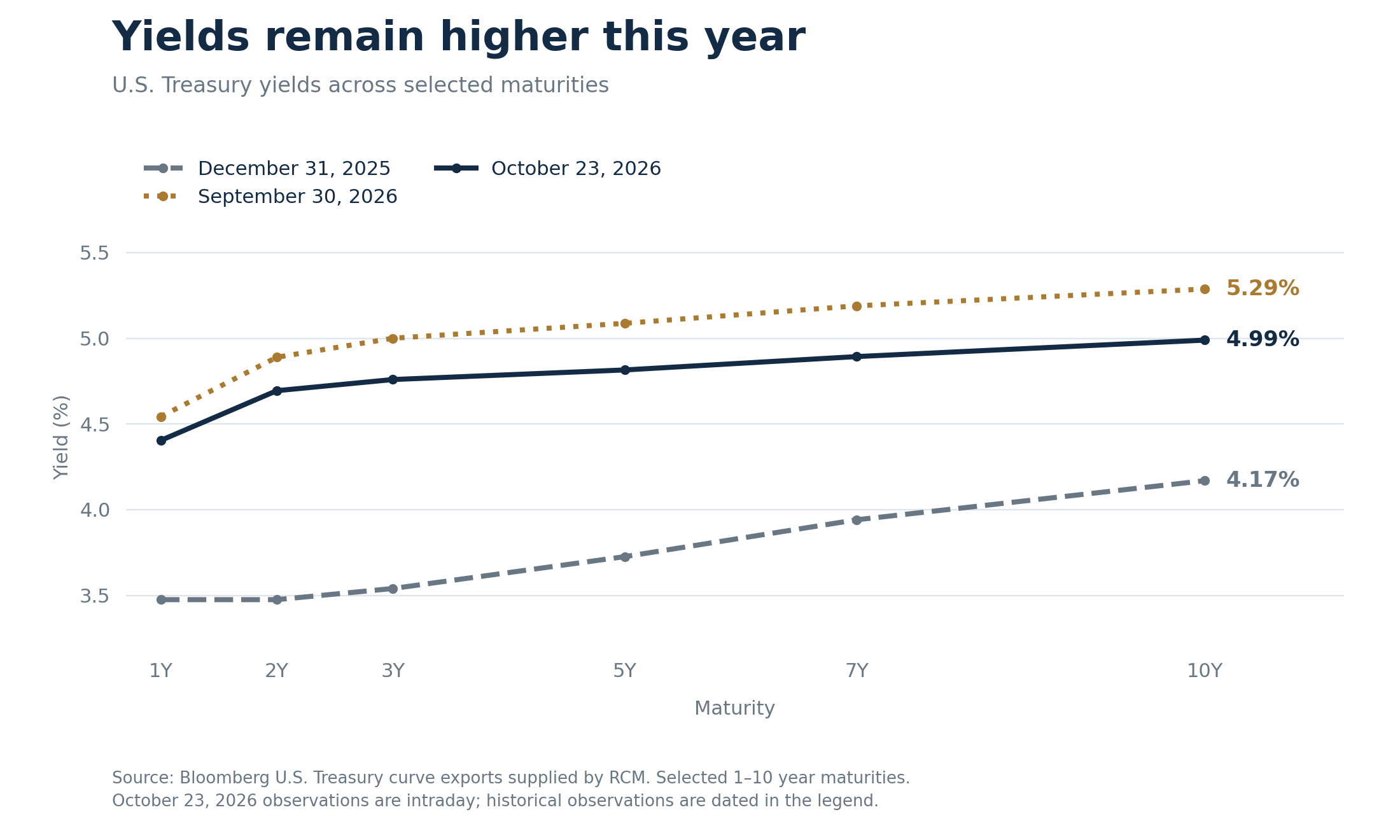
For investors putting money to work, bonds now offer meaningfully higher yields than they did at the start of the year. That creates an opportunity worth examining.
But recognizing an opportunity and deciding how to use it are different tasks. Before choosing a fixed income strategy, we need to ask: What does this money need to do?
What has changed and what has not
Higher yields improve the prospective return available on new purchases of otherwise comparable bonds. They can make fixed income more useful in meeting income needs and funding future expenses.
The transition has also put pressure on existing holdings. When market yields rise, the market prices of bonds with fixed interest rates generally fall. Investors may therefore see lower values on their statements at the same time that new purchases offer more attractive yields.
An existing bond’s scheduled payments do not change simply because market yields have moved. Its sale price can change, however, which matters if the investor needs to sell before maturity. The issuer’s ability to pay and the bond’s terms remain important as well.
Higher yields give us a reason to reassess the opportunities available. The next step is determining where those opportunities fit.
The same opportunity can lead to different decisions
Consider two investors looking at today’s bond market.
One is setting aside money for a home purchase in two years. The other wants to supplement retirement income over the next decade.
For the first investor, the central requirement is having funds available when the purchase occurs. A bond maturing much later might offer an appealing yield, but selling it in two years would mean accepting its market price at that time.
Even a bond with very little risk of default can fluctuate considerably in price before maturity. Matching principal repayments to the expected expense, while allowing for changes in timing, may be more useful than pursuing additional yield.
The second investor has a different objective. After providing for upcoming spending, this investor may use bonds with a range of maturities to generate income and return principal over several years.
Tax circumstances also influence the choice. Municipal bond interest is generally exempt from federal income tax, but the value of that exemption depends heavily on the investor’s tax rate. The higher the applicable tax rate, the more valuable the exemption becomes. A municipal bond that is attractive to an investor in a high tax bracket may offer less income after taxes than a taxable alternative for someone in a lower bracket. In a retirement account, the municipal exemption provides no additional federal tax benefit. Comparing the income an investor would retain after taxes helps determine which bonds best serve the intended purpose.
Both investors can benefit from higher yields. Their needs determine which strategies deserve consideration.
Purpose defines the strategy. Selection puts it to work.
Establishing the purpose of the money does not make yield less important. It gives us a framework for evaluating it. Once the objectives and acceptable risks are defined, we seek attractively priced securities that satisfy those requirements. That involves comparing available bonds and evaluating credit quality, maturity, liquidity, call provisions, and tax treatment.
The comparison below illustrates why tax circumstances and security selection belong in the same discussion. The municipal curve is shown as a tax equivalent yield: the yield a taxable investment would need to offer to match the municipal yield after federal taxes under the stated assumption.
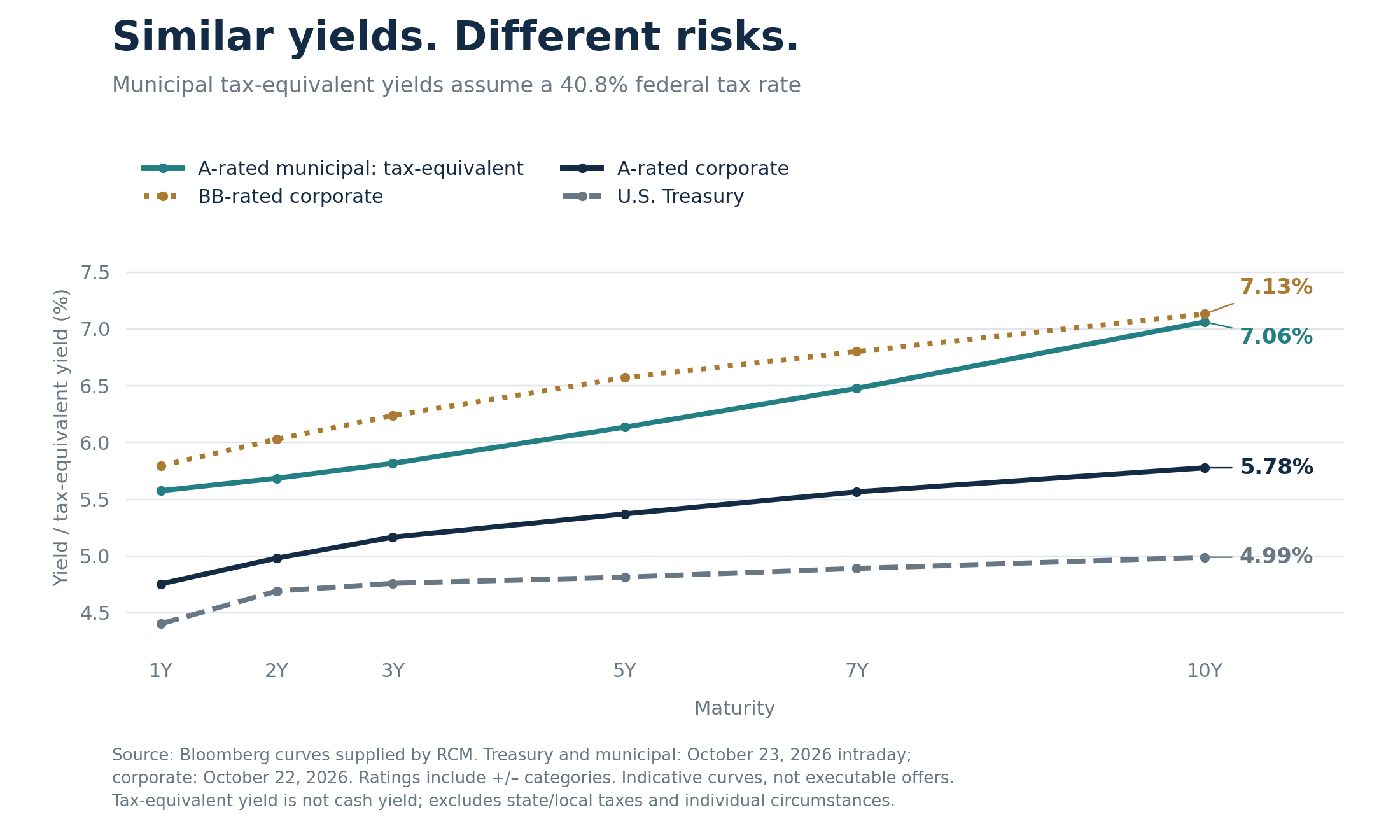
At the ten year point, the municipal tax equivalent yield is close to the BB corporate yield. That proximity does not make the investments interchangeable. Credit quality, call provisions, liquidity, and tax circumstances still affect which bonds fit the investor’s needs. The municipal figure is not the cash yield the bond pays.
The objective is to pursue an attractive return within the boundaries appropriate for that part of the portfolio.
Different purposes within one portfolio
Most households have several needs at once: upcoming expenses, income requirements stretching over several years, and capital intended for growth over decades.
A reserve provides access to money for upcoming spending. A bond ladder, consisting of securities scheduled to mature at different times, can provide income and scheduled principal repayments, assuming issuers meet their obligations. A diversified equity allocation can pursue growth over the long term, with the capacity and willingness to remain invested through substantial declines.
These allocations support one another. Providing for upcoming expenses can reduce the pressure to sell investments intended for the long term during a difficult market.
Each cash flow creates another decision
The work continues after the investments are purchased.
Interest and dividends arrive. Bonds mature or are repaid early. New savings enter the account. Meanwhile, expenses approach and market movements change the relative size of different allocations.
Each arrival of cash presents a choice. Some may fund an upcoming withdrawal. Some may replenish a reserve. Other dollars may extend a bond ladder or support an allocation that has fallen below its intended share of the portfolio.
Cash reserved for spending has a deliberate purpose. Cash awaiting investment requires attention. Leaving it in a default sweep arrangement without reviewing the alternatives can mean earning less than suitable investments offer.
This makes reinvestment an important part of portfolio management. Selecting an attractive bond is one decision. Managing the income and returned principal over time helps determine the results the portfolio actually delivers.
Connecting the opportunity to the plan
At Roosevelt Capital Management, our proprietary technology helps coordinate multiple strategies within a single account. Cash available for investment is directed first to the strategy that needs additional capital relative to its target allocation, then to the appropriate allocation within that strategy. Within a bond ladder, that means identifying the maturity bucket that needs investment. Investment professionals then evaluate and approve suitable securities, considering client restrictions, liquidity needs, and issuer and sector concentration. This process allows incoming cash to replenish underweight allocations and can reduce the need to sell appreciated holdings solely to restore balance.
We build portfolios around each investor’s needs, using time-tested risk management tools so the portfolio’s success does not depend on correctly forecasting interest rates. Diversification, laddered maturities, and disciplined rebalancing help the portfolio adapt as conditions change. Returning principal creates opportunities to invest at prevailing yields, while existing holdings continue to serve their intended roles, subject to issuer payment and the terms of each bond.
We can evaluate the opportunities available today and make deliberate decisions about how to use them.
This year’s rise in yields gives us an opportunity to revisit how bonds can serve those needs. The decisions we make with each available dollar put that plan into practice.
|
KEY TAKEAWAY Higher yields expand the choices available. Putting money to work begins with understanding its purpose, continues through careful security selection, and requires ongoing attention as the portfolio evolves. |
With gratitude,
David and Mike
Sources and Notes
Bloomberg curves supplied by RCM. Treasury and municipal observations: October 23, 2026, intraday; corporate: October 22. Historical dates appear in the chart. Curves are indicative, not executable offers. Municipal tax equivalent yields assume a 40.8% federal tax rate; state and local taxes and individual circumstances are excluded. Rating groups include plus and minus categories. Investor examples are illustrative. Some municipal interest may be subject to federal alternative minimum tax or state and local taxes.
Disclaimer
Roosevelt Capital Management LLC is a registered investment adviser. This commentary is educational and is not individualized investment or tax advice. Investments involve risk, including loss of principal. Diversification, active management, rebalancing, and laddering do not guarantee returns or prevent losses. Past performance does not guarantee future results.