

August 06, 2026
Why the United States stepped into the currency market - and what investors should understand about the risks beneath the headlines.
|
IN BRIEF • The yen’s decline became disorderly. After approaching a forty-year low near 164 yen per dollar, the currency’s weakness was amplifying inflation and financial-market stress. • The United States joined Japan in buying yen. The coordinated July 31 intervention was rare and designed to reinforce the credibility of Japan’s efforts. • The U.S. has its own interests at stake. A destabilized yen can pressure Asian currencies, encourage sales of U.S. Treasury holdings, and raise volatility across global bond markets. • Intervention can buy time, but it cannot solve the underlying imbalance. A durable recovery likely requires narrower interest-rate gaps and greater confidence in Japanese monetary and fiscal policy. |
Dear Investors and Friends,
A note to readers: This month’s letter includes A Plain English Guide to the Yen Crisis following the main commentary. It explains the carry trade, currency intervention, and the U.S. role step by step for readers who may be less familiar with currency markets.
Currency markets are often treated as a specialized corner of finance. But when one of the world’s most important currencies begins moving rapidly, the consequences rarely stay contained.
That is what has happened with the Japanese yen. After years of gradual weakness, the yen fell toward levels not seen in roughly four decades. The move increased the cost of imported energy and food for Japanese households, raised questions about Japan’s economic policy, and began to ripple through global bond and currency markets.
On July 31, Japan’s Ministry of Finance purchased yen in coordination with the U.S. Department of the Treasury. Japan described the action as a response to excessive volatility and disorderly movements. The United States had not joined an operation to support a falling yen since 1998, making the decision unusually significant.
|
A useful distinction A weak currency is not automatically a crisis. The concern arises when the decline becomes rapid, self-reinforcing, and disruptive enough to affect inflation, capital flows, government financing, and confidence in policymakers. |
What Caused the Yen to Weaken?
The simplest explanation is the difference between interest rates in Japan and the United States. Even after the Bank of Japan raised its policy rate to 1.0%, U.S. short-term rates remained materially higher. That gap made it attractive for investors to borrow in yen at relatively low cost and invest in higher-yielding assets elsewhere - a strategy commonly known as the carry trade.
The resulting demand for dollars and supply of yen placed persistent downward pressure on the Japanese currency. Higher energy import costs, uncertainty about future Japanese policy, and doubts about how aggressively the Bank of Japan would tighten monetary policy added to the pressure.
Sources: Japan Ministry of Finance; U.S. Treasury; Bank of Japan; Council on Foreign Relations. Data and events through August 5, 2026.
Why the United States Became Involved
At first glance, supporting the yen may appear to be an act of assistance to an ally. It is that but it also serves several direct U.S. interests.
First, a sharply weaker yen can pull other Asian currencies lower. Export-oriented economies often resist large currency appreciation against regional competitors. If the yen falls far enough, pressure can spread to the Korean won, the Chinese yuan, and other currencies. That can complicate U.S. trade and industrial-policy goals by making Asian goods cheaper in dollar terms.
Second, Japan is one of the largest foreign holders of U.S. Treasury securities. Japan traditionally finances yen-buying intervention by drawing on its foreign-exchange reserves, which are heavily invested in high-quality foreign assets. Large or repeated reserve sales can add pressure to U.S. bond markets at an inconvenient time, potentially contributing to higher Treasury yields and greater volatility.
Third, disorderly currency moves can force leveraged investors to unwind positions quickly. Because the yen has long been used as a funding currency, a sudden reversal can affect equities, credit markets, commodities, and government bonds around the world. U.S. participation sends a stronger warning that authorities are willing to resist one-way speculation.
What the Intervention Actually Did
|
Japan buys yen Japan sells reserve assets or raises yen funding. |
U.S. joins Treasury sells reserve currency and buys yen. |
Market signal Speculators face greater risk; disorderly moves may slow. |
The U.S. Treasury reportedly sold euros from its reserves and purchased yen. That choice allowed the United States to support Japan without directly selling dollars into the market. Japan also said it plans to make use of the Federal Reserve’s Foreign and International Monetary Authorities Repo Facility, which can provide dollar liquidity against Treasury collateral and reduce the need to sell those securities outright.
The operation produced an immediate market reaction. The yen strengthened sharply from levels above 163 per dollar toward the mid-150s. But the longer-term result will depend less on the size of a single transaction than on whether investors believe additional action - including Bank of Japan rate increases - will follow.
What This Means for Investors
The important lesson is not that investors should predict the next move in the yen. Currency intervention is intentionally difficult to forecast, and its effectiveness depends on policy decisions, market positioning, and confidence.
The larger lesson is that stress in one market can migrate quickly into another. A yen problem can become a Treasury-market problem. A Treasury-market problem can affect mortgage rates, corporate borrowing costs, equity valuations, and the pricing of risk throughout a portfolio.
|
KEY TAKEAWAY The U.S. did not intervene simply to make the yen stronger. It acted to reduce the risk that a disorderly currency decline would destabilize Asian exchange rates, force disruptive sales of U.S. Treasury securities, and spread volatility across global markets. The intervention may buy time, but lasting stability will depend on policy changes in Japan. |
Positioning Portfolios for an Uncertain Path
The yen’s path will depend on decisions by Japanese and U.S. policymakers, changes in interest-rate differentials, and the behavior of global investors. We do not believe successful investing requires correctly predicting how those forces will resolve.
At Roosevelt Capital Management, we focus instead on building portfolios that can remain resilient across a range of outcomes. We invest primarily in individual bonds with known cash flows, ladder maturities so principal is regularly returned for reinvestment, and maintain relatively modest duration so portfolios retain flexibility when markets become more volatile.
That approach is particularly relevant when stress can move quickly from currencies to government bonds and broader financial markets. If yields rise, maturing securities and coupon payments can be reinvested at more attractive rates. If yields fall, existing bonds continue to provide their contractual cash flows and may benefit from price appreciation. The objective is not to forecast the next move in the yen, but to construct portfolios that are not dependent on any single currency or interest-rate outcome.
With gratitude,
David and Mike
ROOSEVELT CAPITAL EXPLAINS
A Plain English Guide to the Yen Crisis
Understanding one of the most important stories unfolding in global financial markets
A companion to the August Monthly Newsletter
The headlines surrounding the Japanese yen can seem complicated, filled with unfamiliar terms such as carry trades, currency intervention, and exchange rates. They do not have to be. The following pages explain what is happening - and why it matters - in plain English. You do not need a background in economics or investing to follow along.
Inside this guide: exchange rates | the carry trade | intervention | U.S. involvement | potential outcomes
1. What Does It Mean When the Yen “Falls”?
Exchange rates are quoted as the amount of one currency needed to buy another. When the market says the dollar is worth 160 yen, one U.S. dollar purchases 160 yen. If the quote rises from 140 to 160, the dollar has strengthened and the yen has weakened.
That movement creates winners and losers. Japanese exporters may benefit because overseas revenue converts into more yen, and foreign tourists find Japan less expensive. But Japanese households and businesses pay more for imported oil, natural gas, food, and raw materials. Because Japan imports much of its energy, a weak yen can quickly become an inflation problem.
2. What Is the Carry Trade?
Money tends to move toward higher expected returns. When safe short-term interest rates are substantially higher in the United States than in Japan, investors have an incentive to hold dollars rather than yen.
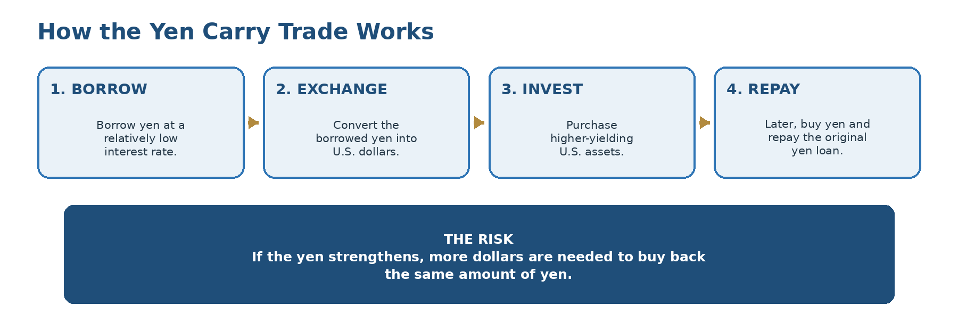
Some investors go further and use the yen as a funding currency. They borrow yen at a relatively low rate, exchange the proceeds for dollars or another currency, and buy a higher-yielding asset. The strategy can be profitable as long as the yen does not strengthen enough to erase the interest advantage.
3. A Simple Example
Imagine your local bank offers loans at just 0.5%, while another bank is paying 5% on deposits. You borrow from the first bank, deposit the money at the second bank, and earn the difference. As long as both rates remain in place, the strategy appears attractive.
Now imagine the loan is not in dollars - it is in Japanese yen. An investor borrows ¥100 million at Japan’s relatively low interest rate, immediately exchanges the yen for U.S. dollars, and invests those dollars in U.S. Treasury securities or other higher-yielding assets.
The investor still owes ¥100 million, not a fixed number of dollars. If the yen becomes more valuable, it takes more dollars to buy back the same ¥100 million needed to repay the loan. The currency loss can erase the interest-rate profit or turn the trade into a loss. When many investors unwind at once, they sell dollar assets and buy yen simultaneously, which can strengthen the yen further and accelerate the reversal.
4. How Currency Intervention Works
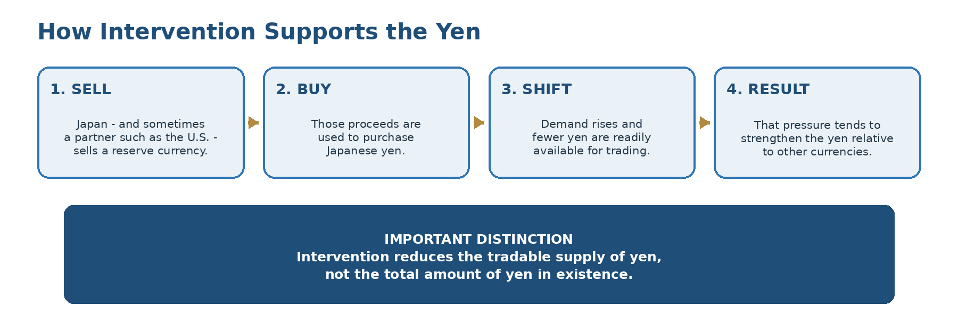
Currency intervention changes supply and demand directly. To support the yen, Japan sells a foreign reserve currency and uses the proceeds to buy yen in the foreign-exchange market. During a coordinated operation, another country may make a similar purchase alongside Japan.
Buying yen increases demand for the currency and temporarily removes those yen from the pool readily available to other market participants. The total number of yen in existence does not change. What declines is the tradable supply of yen in the foreign-exchange market. Higher demand combined with reduced market availability tends to push the yen’s value higher relative to other currencies.
Intervention can be powerful when markets are stretched, investors are crowded into the same position, or the action signals a broader policy shift. But it does not permanently change the return available on yen deposits relative to dollar deposits. If the interest-rate gap remains wide, selling pressure may eventually return.
5. Why U.S. Treasury Holdings Enter the Story
Japan accumulated large foreign-exchange reserves over decades. Those reserves are invested primarily in liquid foreign assets, including U.S. government securities.
When Japan wants to buy yen, it needs to provide another currency to the market. One option is to sell reserve assets for dollars and then exchange the dollars for yen. If an operation is large, investors may worry that Treasury sales will add supply to the bond market. More supply, all else equal, can push bond prices lower and yields higher.
The Federal Reserve’s FIMA Repo Facility offers an alternative source of dollar liquidity. A foreign official institution can temporarily exchange Treasury securities for dollars through a repurchase agreement rather than selling those securities in the open market. Japan’s stated intention to use the facility may reduce the risk of forced Treasury sales during future intervention.
6. Why the United States Is Involved
A sharply weaker yen can affect U.S. interests through several channels. It can place downward pressure on other Asian currencies, complicate trade relationships, and contribute to instability across global markets. It can also increase concern that Japan may need to sell U.S. Treasury securities to finance intervention.
The reported U.S. transaction involved selling euros from official reserves and buying yen. Economically, the United States still added demand for yen, but avoided directly increasing the supply of dollars. U.S. participation also strengthened the signal that authorities were willing to resist disorderly, one-way currency moves.
7. What Could Happen Next?
Several developments could support a more durable stabilization: further increases in Japanese interest rates, lower U.S. rates, calmer energy prices, more predictable policy, or a belief among investors that repeated intervention makes betting against the yen too risky. The strongest result would likely involve more than one of these forces.
Risks remain in both directions. The yen could weaken again if investors believe Japanese policy will not change enough. A sudden, violent rebound could also force carry-trade investors to sell other assets quickly, transmitting volatility to equities, credit, commodities, and government bonds.
8. How Should a Long-Term Investor Think About This?
Most investors do not need to trade the yen to be affected by it. The relevant questions are indirect: Could global bond yields become more volatile? Could a carry-trade unwind affect risk assets? Are companies exposed to Japanese imports, exports, or currency translation? Is a portfolio dependent on a single path for interest rates or exchange rates?
The larger lesson is that stress in one market can migrate quickly into another. Exchange rates influence inflation; inflation influences central banks; central-bank policy influences bond yields; and bond yields influence asset valuations and borrowing costs. These connections do not mean investors should forecast every policy decision. They reinforce the importance of liquidity, known cash flows, diversified maturity structures, and portfolios designed for more than one possible outcome.
KEY TAKEAWAYS
|
|
Why We Thought This Was Worth Explaining
The headlines surrounding the Japanese yen have become increasingly prominent, yet the mechanics behind the story remain unfamiliar to many investors. We believe clients make better long-term decisions when they understand not only what is happening in financial markets, but why. Our goal is not to turn readers into currency experts. It is to provide enough context that the next time this story appears in the news, it will make a little more sense.
Disclaimer
Roosevelt Capital Management LLC is a registered investment adviser. The information presented is for educational purposes only and is not intended to make an offer or solicitation for the sale or purchase of any specific securities, investments, or investment strategies. Investments involve risk and are not guaranteed. Be sure to first consult with a qualified financial adviser and/or tax professional before implementing any strategy discussed herein.
Past performance is not indicative of future performance. Principal value and investment return will fluctuate. No guarantees or assurances that the target returns will be achieved, or objectives will be met are implied. Future returns may differ significantly from past returns due to many different factors. Investments involve risk and the possibility of loss of principal.
While all the values used in this report were obtained from sources believed to be reliable, all calculations that underly numbers shown in this report believed to be accurate, and all assumptions made in this report believed to be reasonable, Roosevelt Capital Management LLC neither represents nor warrants the values, calculations or assumptions and encourages each prospective investor to conduct their own review of the audits, values, calculations and assumptions.